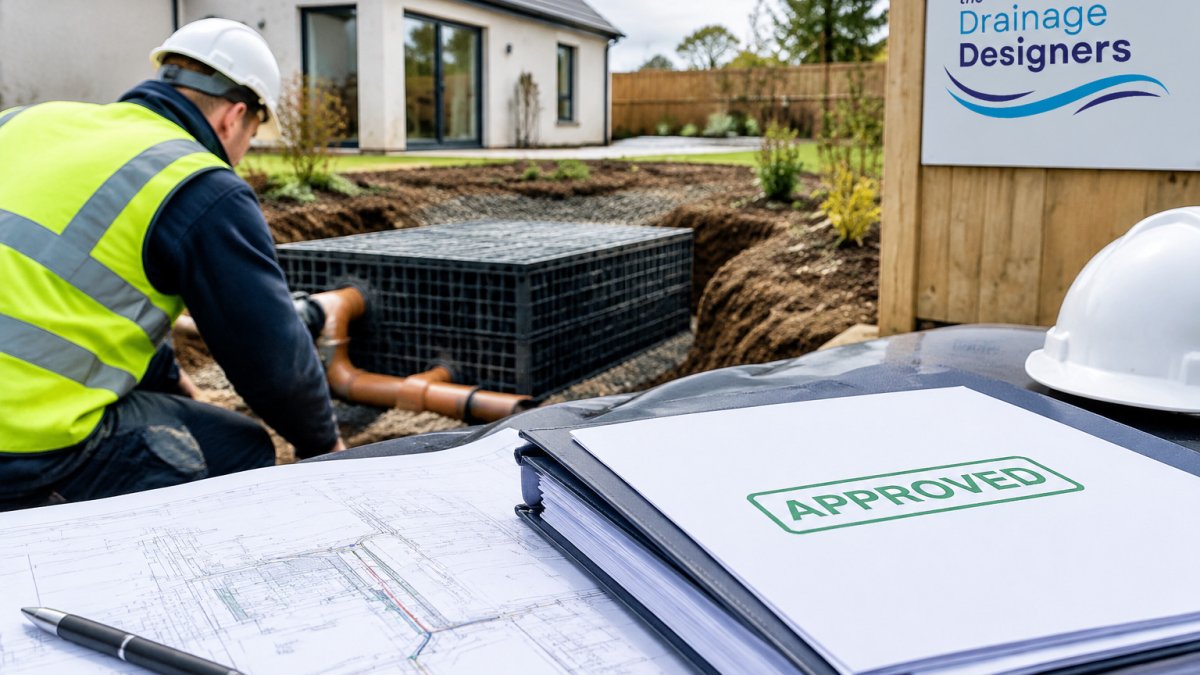
 Knowledge Centre
What Does SuDS Compliant Mean? A Clear Guide
Table of Contents
- What Does SuDS Compliant Mean?
- SuDS Planning Requirements You Need to Know
- How SuDS Drainage Design Works on a Real Site
- Is Your Driveway SuDS Compliant?
- Why a SuDS Maintenance Plan Matters
- Common Myths About SuDS Compliance
- Conclusion
- Frequently Asked Questions
Last Updated: 18 October 2026
What Does SuDS Compliant Mean?
SuDS compliant means a drainage scheme meets the Sustainable Drainage Systems standards set by the planning authority, managing rainwater by slowing it down, storing it, and letting it soak away or drain gradually rather than piping it straight to the sewer. In practice, it means the design has been checked against local and national rules before approval.
If you are planning an extension, a new build, or a driveway, this is the phrase that decides whether your application moves forward or stalls. The honest answer is that compliance is less about one magic product and more about proving your site handles water responsibly.
The core idea is simple. Rain that falls on your site should leave at roughly the same rate as it did before you built anything. A SuDS scheme slows the flow, filters out pollution, and reduces flood risk downstream. That is the whole principle.
Below, we break down what the rules ask for, how a real design comes together, and where most applications go wrong.
SuDS Planning Requirements You Need to Know
The first thing to understand is that SuDS planning requirements are not a single national checklist. They come from a mix of national planning policy and local authority rules, and the local rules often decide the outcome.
A common approach is a drainage hierarchy. You must show you have worked through the options in order, preferring the most sustainable:
- Rainwater harvesting and reuse first
- Infiltration to the ground where soil allows
- Attenuation, storing water and releasing it slowly
- Discharge to a watercourse
- Discharge to a surface water sewer as a last resort
Your application usually needs a drainage statement or strategy that proves this sequence. Larger schemes also need a flood risk assessment. The Lead Local Flood Authority (LLFA) is the body that reviews the drainage side, and their comments carry real weight with the planning committee.
What most guides miss is that each authority interprets the rules differently. Some want very detailed calculations up front. Others accept an outline strategy at the first stage. Getting this wrong is the fastest route to a refusal or a string of conditions.
How SuDS Drainage Design Works on a Real Site
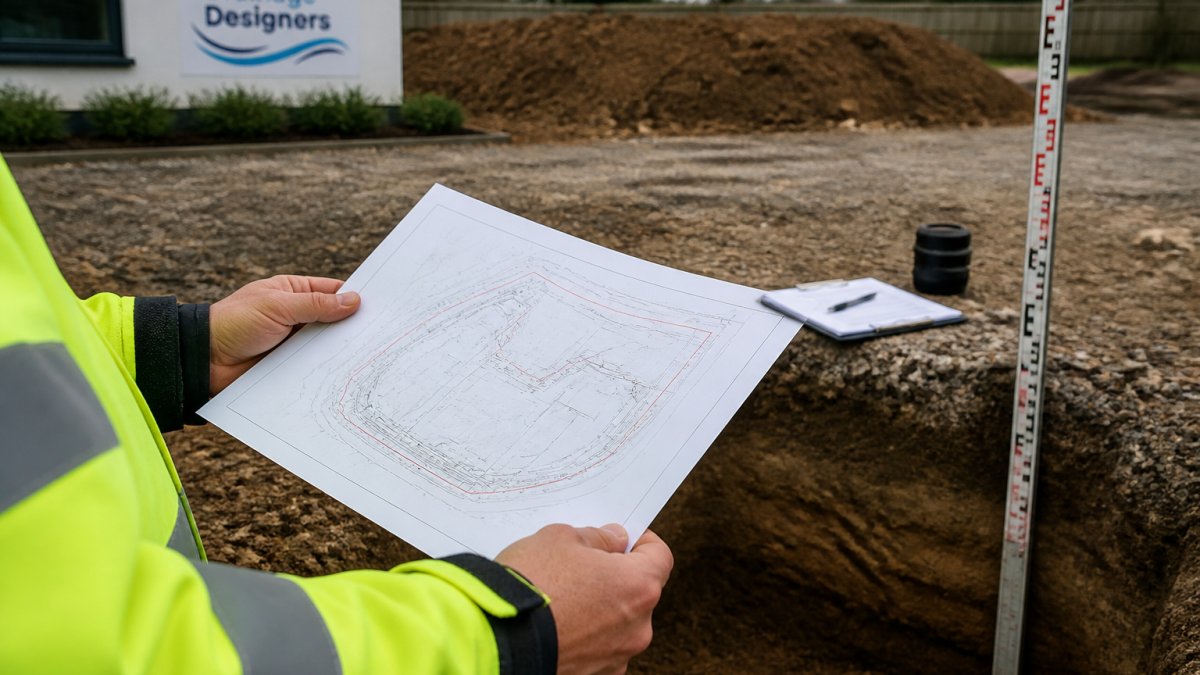
SuDS drainage design starts with the ground, not the drawing board. Before any pipe or tank is specified, it is important to know what the soil does with water.
The process tends to run in this order:
- Site visit and survey to map levels, boundaries, and existing drainage.
- Ground investigation, often a soakaway test, to see whether water infiltrates.
- Flow calculations to work out how much rain the site must manage.
- Design of the system, choosing between soakaways, attenuation tanks, permeable paving, or a mix.
- Documentation for the council, including drawings and calculations.
The ground investigation is the part people skip, and it is the part that matters most. If the soil is clay and does not drain, infiltration is off the table and you move down the hierarchy to attenuation. That single fact changes the whole design and often the cost.
A well-run design also accounts for how the system will be maintained for years after the build. More on that shortly.
Is Your Driveway SuDS Compliant?
A SuDS compliant driveway is one that lets rainwater drain away without sending it to the public sewer. The simplest way to achieve this is with permeable surfaces, such as permeable block paving, gravel, or porous asphalt, laid so water passes through to the ground below.
Here is where the rules catch people out. In many areas, you can pave over your front garden without planning permission, but only if the surface is permeable or the water drains to a permeable area within your boundary (Planning permission - Paving your front garden). If you use a solid, non-permeable surface, you may need to apply for planning permission.
A practical checklist for a compliant driveway:
- Choose a permeable surface, or direct runoff to a planted border or lawn
- Confirm the sub-base is suitable for infiltration
- Check the slope so water flows away from the house, not towards it
- Keep the drainage within your property boundary
- Keep records of the materials used for any future sale
If your ground is heavy clay, a permeable surface alone may not be enough. In that case, the driveway may need to connect to an attenuation system that stores water before it drains away.
Why a SuDS Maintenance Plan Matters
A SuDS maintenance plan is the document that sets out who looks after the system, how often, and what they do. Without one, even a well-designed scheme can fail within a few years.
Councils increasingly ask for this at the planning stage, not after. The reason is simple: a soakaway or attenuation tank silts up over time. Permeable paving clogs if it is never swept. If nobody owns the upkeep, the system stops working and the flood risk returns.
A workable plan usually covers:
- Routine inspection of inlets, outlets, and storage areas
- Clearing silt and debris on a set schedule
- Sweeping permeable surfaces to keep pores open
- Recording each check so there is a paper trail
- Naming the person or body responsible
For homeowners, this can be a short document. For larger developments, it often becomes a formal management arrangement. The point is accountability. A plan that names no one is not a plan.
Common Myths About SuDS Compliance
Myths about SuDS compliance cause more wasted time than almost anything else. Here are the ones we hear most, and what is actually true.
Myth: SuDS is only for big developments. Not true. Small extensions and driveways can trigger drainage conditions, and the same principles apply at any scale.
Myth: One product makes you compliant. No single tank or paving type guarantees approval. Compliance comes from a design that suits the site and is properly documented.
Myth: If the council does not mention drainage, you can ignore it. Conditions are often added later. It is far cheaper to design for drainage from the start than to fix it after a refusal.
Myth: A SuDS scheme needs constant, expensive upkeep. A sensible plan with routine checks is usually low cost. Neglect is what gets expensive.
The pattern behind all four is the same. People look for a shortcut, and drainage does not reward shortcuts. It rewards a proper look at the site.
Conclusion
Getting drainage right is one of the least glamorous parts of a project, and one of the most important. A scheme that manages water properly keeps your planning application on track and protects your property for years.
We handle the whole process for homeowners, architects, and developers. That includes site visits, flood risk assessments, SuDS drainage design, and the documentation your local authority needs. Our aim is straightforward: designs that meet the rules and get approved without unnecessary delay.
If you are unsure whether your project needs a SuDS scheme, get in touch. We will tell you honestly what is required and what it involves.
Frequently Asked Questions
What makes a driveway SuDS compliant?
A driveway is SuDS compliant when rainwater can drain through or away from the surface without overwhelming the sewer network. Permeable paving, gravel, and porous asphalt all qualify because water passes through to the ground below. The key is that surface water is managed at source rather than piped straight to a drain. If you are replacing a lawn or garden with hardstanding, the surface must allow water to soak away naturally or drain to a compliant system.
Do I need planning permission for a new driveway?
In many cases a new driveway falls under permitted development, but only if the surface is permeable or water drains to a permeable area within your property boundary. If you use non-permeable materials and water runs onto the highway or into the sewer, you will likely need planning permission. Checking your local authority's requirements early avoids a costly retrospective application. A drainage designer can confirm whether your plans need approval before work starts.
Who approves SuDS proposals for a planning application?
The Lead Local Flood Authority (LLFA) is the statutory consultee for surface water drainage on major developments, and the local planning authority makes the final decision. For smaller schemes, the local authority may still ask for drainage details. The LLFA reviews whether your SuDS drainage design meets the non-statutory technical standards, including water quality, flow rates, and maintenance arrangements. Getting the design right before submission reduces the risk of conditions or refusal.
What information should a SuDS drainage plan include?
A SuDS drainage plan should show the layout of drainage features, calculations for surface water run-off, and evidence that the system meets the non-statutory technical standards. It should also include a SuDS maintenance plan setting out who is responsible for upkeep and how often inspections happen. Details of ground conditions, infiltration rates, and how the system connects to the wider drainage network all belong in the plan. Clear drawings and calculations make approval more straightforward.