 Knowledge Centre
Property Development: How to Keep Projects on Schedule
Last Updated: 29 October 2026
Quick Summary
A property development schedule keeps projects on time when it is built first and controls sequence, duration, dependency and float. Programme design and approvals before the build, because third-party gates carry more schedule risk than construction itself. Track float remaining on the critical path weekly and hold calculated contingency rather than a token figure.
- Link every task to its predecessor and owner, because templates without dependencies are decoration.
- Sum the critical path durations to set your baseline total project duration.
- Set milestones at approvals such as drainage approval secured, not only at physical progress.
- Ask each authority for its current stated turnaround and add your own buffer on top.
- Calculate contingency by multiplying likelihood by impact for the ten risks most likely to affect the critical path.
Table of Contents
- Why a Property Development Project Schedule Decides Delivery
- Building a Project Schedule Template for Construction That Works
- Setting Construction Project Milestones and Phases
- Planning Design, Pre-Construction and Drainage Approvals
- Coordinating Contractors, Consultants and Long-Lead Procurement
- Managing Construction Project Delays Before They Spread
- Tracking Progress: Schedule KPIs and Reporting
- Get Your Drainage Design Timed Into the Programme
- Frequently Asked Questions
Why a Property Development Project Schedule Decides Delivery
A property development schedule is the single document that decides whether a scheme completes on time or bleeds money through extended preliminaries, extended finance costs and frustrated buyers, so the property development schedule deserves to be built first, not last. Where drainage and regulatory work is bolted on at the end as an afterthought, the programme is far more likely to slip.
The cost of an unrealistic programme
An unrealistic programme does not just slip. It slips in a way that compounds. A missed drainage approval pushes the start on site, which pushes the frame, which pushes the handover, and every week of delay carries standing costs on plant, site staff and borrowing.
Most programmes we review are optimistic in the same three places:
- Pre-construction design and approvals, treated as a formality
- Utility and drainage connections, assumed to run in parallel with construction
- Contingency, set at a token figure rather than a calculated one
What a schedule must control
A working programme controls four things: sequence, duration, dependency and float. Get those right and the schedule becomes a decision tool. Get them wrong and it becomes a wish list that nobody trusts by month three.
The most common mistake is treating the programme as a construction document. In practice, the design stage and the approval stage carry more schedule risk than the build itself, because they depend on third parties you do not control.
Building a Project Schedule Template for Construction That Works
A project schedule template for construction is only useful if it forces you to name every task, its duration, its predecessor and its owner. Templates that list phases without dependencies are decoration. Build the logic first, then format it.
Work breakdown and task dependencies
Start with a work breakdown structure that goes down to the level you will actually manage. For a residential scheme that usually means:
- Site appraisal and feasibility
- Planning application and supporting reports
- Detailed design, including drainage and levels
- Building control and warranty approvals
- Procurement and long-lead ordering
- Enabling works and groundworks
- Substructure, drainage installation and services
- Superstructure and envelope
- Fit-out, commissioning and handover
Then link them. Drainage design is not a standalone task: it depends on levels, it feeds the planning submission, and it constrains the groundworks sequence. Miss those links and the programme looks fine on paper while being undeliverable in practice.
The critical path and why it matters
The critical path is the longest chain of dependent tasks through the programme. Any delay on that chain moves the completion date. Any delay off it only eats float.
Here is a simplified worked example for a small residential scheme:
| Task | Duration | Predecessor | Float |
|---|---|---|---|
| Topographic survey and levels | 2 weeks | None | 0 |
| Outline drainage strategy | 3 weeks | Survey | 0 |
| Planning submission | 1 week | Drainage strategy | 0 |
| Detailed drainage design | 4 weeks | Planning submission | 2 weeks |
| Building control approval | 6 weeks | Detailed design | 1 week |
| Groundworks and drainage installation | 8 weeks | Building control approval | 0 |
| Superstructure | 12 weeks | Groundworks | 0 |
The critical path runs straight down the middle: survey, strategy, planning, detailed design, approval, groundworks, frame. That tells you where to spend your management attention. A week lost on the drainage strategy is a week lost on handover.
Calculating float and total project duration
Float is the amount of time a task can slip without affecting the critical path.
To calculate total project duration, sum the durations along the critical path: 2 + 3 + 1 + 4 + 6 + 8 + 12 = 36 weeks.
A common mistake is to treat float as spare time to be used up. Float is a buffer against risk.
Building the template in practice
A workable template has columns for task ID, description, duration, start date, finish date, predecessors, float, owner and percent complete. Keep it in a spreadsheet or a dedicated scheduling tool, but the format matters less than the discipline of updating it weekly.
For a more detailed walkthrough of how drainage tasks sit on the critical path, see our guide to obtaining drainage approval for planning permission.
Setting Construction Project Milestones and Phases
Construction project milestones should mark decisions and approvals, not just physical progress. "Frame complete" is a milestone. So is "drainage approval secured", and the second one usually matters more.
Set milestones at these gates:
- Planning submission and determination
- Discharge of drainage-related planning conditions
- Building control plan approval
- Start on site
- Watertight
- Practical completion
Each milestone needs an owner, a date and a definition of done. Without a definition of done, milestones become opinions.
Planning Design, Pre-Construction and Drainage Approvals
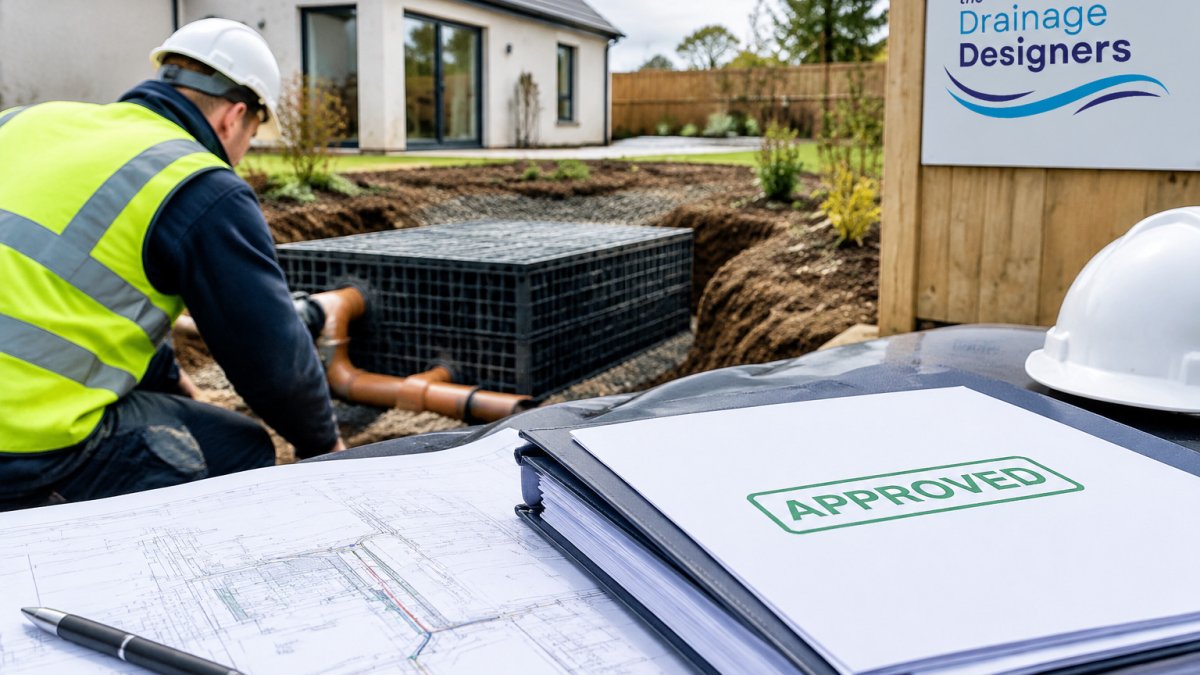
Design and pre-construction work is where the programme is won or lost, and drainage approvals sit right in the middle of it. A drainage scheme that is not coordinated with levels, finished floor heights and the surface water strategy will come back with conditions, and conditions cost weeks.
Regulatory lead times to build into the programme
Lead times vary by authority and by the complexity of the site, so no fixed number of weeks should be assumed for any of them. What we do recommend is that you ask each authority for its current stated turnaround at the point you programme the work, and add your own buffer on top.
The sequence to programme is broadly:
- Pre-application discussion with the local planning authority
- Submission of the drainage strategy and any flood risk information
- Consultation with the Lead Local Flood Authority
- Determination, and discharge of any drainage conditions
- Building control and sewerage undertaker approvals
If you are working through the approval route, our guide to obtaining drainage approval for planning permission sets out the process step by step. Where an objection has been raised, it helps to understand how long LLFA objection resolution typically takes before you commit a date to your funder. Official guidance on the planning system is available from GOV.UK planning practice guidance, and the technical standards for sustainable drainage are set out by Defra's non-statutory technical standards for sustainable drainage systems.
Coordinating Contractors, Consultants and Long-Lead Procurement
Coordination fails at the interfaces, not in the middle of anyone's package. The groundworks contractor needs the drainage design before he prices. The architect needs the levels before she details the thresholds.

Procurement is where the schedule gets tested. Long-lead items, from drainage components to utility connections, need to be identified at design stage and ordered against the programme, not against optimism.
Building a procurement schedule
A procurement schedule is a separate document that links each long-lead item to its design sign-off date, its supplier lead time and its required-on-site date. Without it, procurement becomes a series of panicked phone calls.
For a typical residential scheme, the procurement schedule should cover:
- Drainage components such as attenuation tanks, flow control devices and inspection chambers
- Utility connections, including water, electricity and gas, each with their own application and lead time
- Structural materials such as steel beams or precast floors
- Windows and doors, which can have long lead times
- Kitchen and bathroom fittings if specified early
- External works materials such as paving and landscaping products
Each item needs an owner, a design freeze date, a supplier lead time and a required-on-site date. The required-on-site date should be derived from the programme, not guessed.
UK-specific lead times and approvals
Some lead times are within your control and some are not. Utility connections are a common source of delay because they depend on the relevant utility company's programme.
Building control approval is another gate that affects procurement.
A practical habit that pays for itself: hold a short weekly coordination call with a fixed agenda covering design status, approvals status, procurement status and the next two weeks of site activity. Twenty minutes, four headings, no slides.
If you are assembling a consultant team and need to know how to hire drainage consultants who will meet schedule commitments, start there before you fix dates.
Managing Construction Project Delays Before They Spread
Construction project delays rarely arrive as a single event. They arrive as a series of small slips that individually look harmless and collectively destroy the completion date.
Contingency and quantified schedule risk
Contingency should be calculated, not guessed. A simple method that works on residential schemes:
- List the ten risks most likely to affect the critical path
- Give each a likelihood and a duration impact in weeks
- Multiply likelihood by impact to get an expected delay
- Sum the expected delays and hold that as schedule contingency
This gives you a defensible number to take to a lender or a client, rather than a round-figure buffer that gets eaten in the first month.
Tracking Progress: Schedule KPIs and Reporting
Progress tracking only works if you compare planned against actual at task level, weekly, and report the variance rather than the headline. A programme that says "on track" while three critical tasks are late is worse than no report at all.
The measures we would track on any development:
- Planned versus actual start and finish, per task
- Float remaining on the critical path
- Number of open approvals and conditions
- Long-lead items ordered versus required on site
- Weeks of schedule contingency remaining
Reporting should be one page. If you want to see how validation timing affects outcomes, our analysis of drainage plan validation and approval success is a useful reference point.
Get Your Drainage Design Timed Into the Programme
The challenge is straightforward: drainage design and approvals sit on the critical path of most residential schemes, and they are the part most programmes handle last.
At The Drainage Designers, we work to your programme rather than ours. Our drainage design service for residential developers covers site visits, flood risk assessment, detailed design and support through local authority and Lead Local Flood Authority approval.
Get in touch with The Drainage Designers to discuss timing your drainage design into the programme.
Frequently Asked Questions
How do you create a realistic property development schedule?
Start with a work breakdown that lists every task, then link dependencies so you can see which items drive the critical path. Add realistic durations for planning, building control and drainage approvals rather than optimistic ones. Build in contingency for weather and long-lead materials, and review the programme at each milestone. A property development schedule is only useful if it reflects how long approvals and procurement actually take, not how long you hope they will.
What commonly causes construction project delays?
The most frequent causes are late design decisions, incomplete drainage or flood risk information, slow planning and building control responses, and long-lead materials arriving after the team is ready. Poor coordination between contractors and consultants also causes knock-on delays. Most construction project delays can be traced to a dependency that was not mapped or a decision that was left too late, so early procurement and clear client decision dates protect the programme.
How should a project schedule account for planning approvals and drainage design?
Treat drainage design and flood risk work as early tasks, not afterthoughts. A site visit and outline drainage strategy should sit before the planning submission so the Local Authority and Lead Local Flood Authority have what they need. Allow realistic time for responses and conditions, and keep drainage design progressing alongside architectural work. When drainage is sequenced properly, approvals are less likely to stall the start on site.
How can developers track progress against a project schedule?
Compare planned versus actual dates at every site meeting and record the reasons for any slippage. Use a small set of schedule KPIs such as percentage of milestones met, float remaining on the critical path, and the number of open design queries. Update the programme weekly and share it with contractors, consultants and the client so everyone works from the same version. Regular reporting catches drift early, while it is still cheap to correct.