 Knowledge Centre
Local Authority Drainage Requirements for Developers
Table of Contents
- Why Drainage Requirements Decide Planning Outcomes
- Who Approves What: Local Planning Authority and Lead Local Flood Authority
- Preparing a Drainage Strategy Report for Planning
- Surface Water Drainage Requirements for Planning
- Flood Risk Assessment for Developers: What Needs Testing
- SuDS Planning Requirements and Local Design Standards
- Submission Checklist and Approval Timelines
- Common Mistakes That Get Drainage Plans Rejected
- Frequently Asked Questions
Last Updated: October 12, 2026
Why Drainage Requirements Decide Planning Outcomes
Drainage requirements are the rules a local planning authority sets for how surface water leaves a development site. They decide whether your planning application sails through or stalls at the first technical review. A scheme can pass design, access and heritage checks, then fail because nobody proved where the rainwater goes. Below, we break down who approves what, what to submit, and how to avoid the mistakes that send plans back.
Who Approves What: Local Planning Authority and Lead Local Flood Authority
Two bodies shape your drainage approval, and confusing their roles is the most common early mistake. The Local Planning Authority (LPA) grants planning permission. The Lead Local Flood Authority (LLFA) advises on surface water. One decides, the other comments. Both matter.
The Local Planning Authority's Role
The LPA is your council's planning department. It determines the planning application and attaches planning conditions. Those conditions often require a detailed drainage design before work starts. The LPA checks your scheme against national planning policy and its own local plan.
When the Lead Local Flood Authority Becomes a Statutory Consultee
The LLFA is a statutory consultee for major development. It reviews your surface water strategy and flood risk assessment. It does not grant permission. It gives technical advice the LPA usually follows. On smaller schemes, the LLFA may not comment at all, so check your council's local validation list early.
Preparing a Drainage Strategy Report for Planning
A drainage strategy report for planning is the document that proves your surface water plan works. It sets out how you will manage runoff, where it discharges, and how the system will be maintained. A weak report is the fastest route to a rejection. A clear one answers the LLFA's questions before they are asked.
What the Report Must Contain
Most authorities expect the same core sections:
- Site location plan and existing drainage features
- Proposed drainage layout with pipe sizes and levels
- Runoff calculations for the developed site
- Discharge destination and the drainage hierarchy you followed
- Attenuation storage sizing and climate change allowance
- Infiltration testing results or a reason they are not needed
- A maintenance plan naming who owns and maintains each element
Check the UK Government's planning practice guidance on sustainable drainage for the national framework behind these expectations.
Surface Water Drainage Requirements for Planning
Surface water drainage requirements for planning centre on one question: where does the water go, and at what rate? You must show the discharge rate, the discharge destination, and how you control flow. The drainage hierarchy decides the order you try options.
Runoff Rates, Discharge Destinations and the Drainage Hierarchy
The drainage hierarchy runs from most to least preferred:
- Infiltration to the ground
- Discharge to a watercourse
- Discharge to a surface water sewer
- Discharge to a combined sewer, as a last resort
You compare your proposed discharge rate against the greenfield runoff rate for the site. That is the rate the undeveloped site would produce. Councils often require you to match it or come close. Ground conditions and infiltration testing decide whether option one is even possible.
| Step | What to Check | Why It Matters |
|---|---|---|
| Infiltration | Ground conditions, water table | Most preferred option |
| Watercourse | Consent and capacity | Needs landowner agreement |
| Surface water sewer | Sewer capacity | Often restricted by the water company |
| Combined sewer | Last resort only | Rarely approved for new sites |
Flood Risk Assessment for Developers: What Needs Testing
A flood risk assessment for developers tests whether your site floods and how your scheme changes flood risk elsewhere. It covers river, surface water, groundwater and sewer flooding. You must show the development stays safe and does not push water onto neighbours.
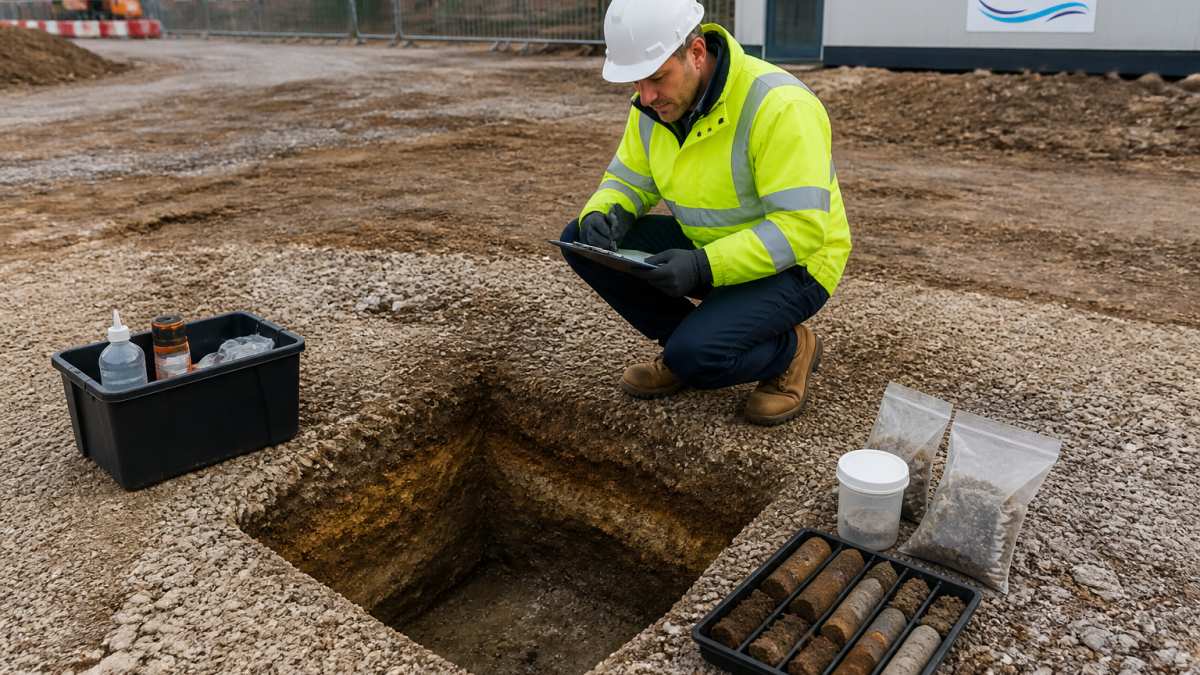
Infiltration testing is the piece most developers skip. A soakaway test tells you whether the ground can take water at all. Without it, your whole strategy may rest on an assumption. Test early, because results shape the design. The Environment Agency's flood risk guidance sets out how flood zones affect what you must submit.
SuDS Planning Requirements and Local Design Standards
SuDS planning requirements push you toward Sustainable Drainage Systems that manage water close to where it falls. SuDS slow runoff, filter pollution and add storage. They are not a single product. They are a set of techniques used together.
Common SuDS elements include:
- Permeable paving
- Soakaways and infiltration basins
- Swales and filter strips
- Attenuation tanks and ponds
- Green roofs
Local design standards vary. Some councils publish their own SuDS guidance. Others lean on national standards. Climate change allowance, water quality and pollution control all feed into the design. So does the maintenance plan, because a SuDS scheme nobody maintains will fail.
Submission Checklist and Approval Timelines
Most guidance stops at the planning submission. In practice, drainage evidence is requested at several stages, and missing a piece at any one of them can stall your scheme. Use the checklist below to map evidence to each stage, and build the review dependencies into your programme from the start.
| Stage | Evidence Needed | Who Reviews It | Typical Timing |
|---|---|---|---|
| Pre-application | Site constraints, initial ground assessment, early drainage hierarchy appraisal | Local Planning Authority (LPA) planning officer, possibly the Lead Local Flood Authority (LLFA) if major | Before design work begins |
| Planning submission | Drainage strategy report, flood risk assessment, runoff calculations, infiltration test results (or justification for their absence) | LPA validation team, then LLFA as statutory consultee | With the application |
| LLFA consultation | Detailed calculations, attenuation sizing, climate change allowance, maintenance plan | LLFA technical officer | During determination, usually within the consultation window |
| Discharge of conditions | Detailed design drawings, construction details, updated maintenance plan, adoption agreements | LPA planning conditions officer, sometimes the sewerage undertaker | Before any work starts on site |
| Post-approval | As-built drawings, verification reports, adoption certificates, handover evidence | LPA, LLFA, sewerage undertaker, or adopting body | On completion, before final sign-off |
Timelines vary by authority and scheme complexity. Major applications take longer because the LLFA review adds a formal step. A common pattern is for the LLFA to respond within 21 days of consultation, but this is not guaranteed and can extend if further information is requested. Build that response time into your programme, not on top of it. Early engagement with the LLFA, even before a full application, can reduce the risk of a request for further information and keep the determination on track.
For post-approval delivery, plan for construction verification and adoption. The sewerage undertaker may adopt surface water sewers under a Section 104 agreement, but this requires the system to meet its design and construction standards. SuDS features are often maintained by a management company or the local authority, and the maintenance plan must name who owns and maintains each element. Without this, the LLFA may consider the scheme undeliverable.
Common Mistakes That Get Drainage Plans Rejected
Rejections follow patterns, and most are avoidable. The biggest is submitting a strategy with no runoff calculations. The second is ignoring the drainage hierarchy and jumping straight to a sewer connection. The third is a missing or vague maintenance plan, which leaves the LLFA unable to confirm the scheme is deliverable.
Other frequent problems:
- No climate change allowance in the storage sizing. The LLFA expects you to use the current allowance, which varies by region and is updated periodically.
- Discharge rate set higher than the greenfield runoff rate. Councils often require you to match it or come close, and a higher rate can be refused.
- Ground conditions not investigated before design. Without a ground investigation, your infiltration assumptions are guesswork.
- No named owner for future maintenance. The LLFA needs to see who will maintain each element for the lifetime of the development.
- Local validation requirements not checked. Each authority publishes its own list, and what is acceptable in one area may be rejected in another.
- Conflicts between local guidance and national policy not resolved. Where they differ, the local plan usually takes precedence, but you should confirm with the LPA.
To avoid these, start with the local validation list, commission infiltration testing early, and follow the drainage hierarchy in order. If you are unsure how local standards apply to your site, request a pre-application meeting with the LPA and, for major schemes, the LLFA. That early conversation can save months of redesign.
Frequently Asked Questions
What drainage information do local authorities require for a planning application?
Most applications need a drainage strategy showing how surface water and foul flows will be managed. This includes existing and proposed runoff rates, discharge destinations, and evidence supporting your chosen drainage hierarchy option. Where infiltration is proposed, infiltration testing results and groundwater information are expected. On larger sites, the Lead Local Flood Authority will also review flood risk and exceedance flow arrangements before the Local Planning Authority decides.
When does a development need a drainage strategy report for planning?
A drainage strategy is normally expected for any development that changes surface water runoff, which covers most new builds, extensions and conversions. Smaller householder schemes may only need a short statement, while major developments require a full report with calculations, a maintenance plan and SuDS design details. Check your Local Planning Authority's validation checklist early, because missing drainage documents are a common cause of delayed applications.
Who approves surface water drainage proposals for a development?
The Local Planning Authority grants planning permission and can attach drainage-related planning conditions. The Lead Local Flood Authority acts as a statutory consultee on surface water matters for major applications and advises the Local Planning Authority, but it does not issue the permission itself. Sewerage undertakers and the Environment Agency may also need to be consulted, depending on where your discharge destination sits.
How can developers address drainage objections from a planning authority?
Read the consultee response carefully and respond to each point with evidence rather than reassurance. Common objections cover greenfield runoff rates, missing infiltration testing, unclear exceedance flow routes or an incomplete maintenance plan. Providing revised calculations, updated ground condition data and a clear drainage design usually resolves technical objections. Early engagement with the Lead Local Flood Authority before submission reduces the chance of objections arising at all.
Drainage is where good schemes quietly fail, and the rules differ from one authority to the next. The Drainage Designers take that burden off your desk, from site visits and infiltration testing to flood risk assessments and securing local council approvals. We work with homeowners, architects and developers nationwide, and we keep the process transparent from first drawing to final sign-off. Get in touch to find out how we can get your drainage strategy approved on schedule.