 Knowledge Centre
How to Check if You Need a Permit for Residential Drainage
Last Updated: November 9, 2026
Quick Summary
You need a permit for residential drainage when you connect a new drain to the public foul sewer, build over or near a public sewer, or when an off-mains system discharges above the general binding rules threshold. Replacing a damaged drain like-for-like or installing a soakaway for clean roof water normally needs no permit.
- Foul water needs a connection approval or environmental permit, while clean surface water usually needs none.
- Only a sewage treatment plant producing compliant effluent can discharge to surface water.
- Connecting to the public sewer requires approval from the sewerage undertaker before work starts.
- Building Regulations Part H approval is separate from the undertaker's connection approval.
- Each UK nation has its own regulator and permit route, so check the rules where the property sits.
Table of Contents
- Residential Drainage Planning Permission: What Triggers It
- Septic Tank Discharge Rules and General Binding Rules
- Sewage Treatment Plant Permit Requirements
- How to Connect to Public Sewer Approval
- Permit Rules Across England, Wales, Scotland and Northern Ireland
- How to Apply: Evidence, Timescales and Common Mistakes
- Get Your Drainage Design Checked Before You Apply
- Frequently Asked Questions
Residential Drainage Planning Permission: What Triggers It
A permit for residential drainage is usually needed when your project connects to or alters a public sewer, or when an off-mains system discharges above the general binding rules threshold. This guide explains when that applies.
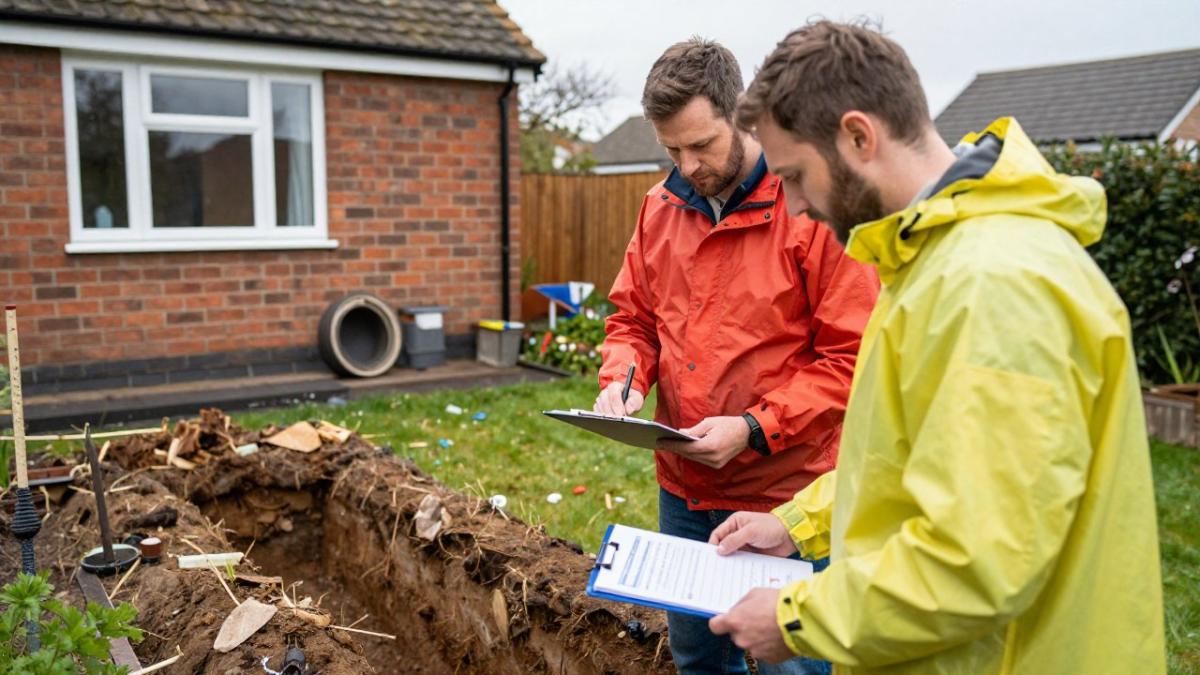
"Residential drainage" covers two very different types of water. One is clean rain running off your roof and driveway. The other is wastewater from sinks, baths and toilets. They follow separate rules, and mixing them up is the most common reason applications get held up.
Below, we break down the triggers, the exemptions, and the steps to follow so you know whether you need to apply at all.
Foul drainage versus clean surface water
Foul drainage carries wastewater from inside the home to a sewer or treatment system. Surface water drainage carries clean run-off from roofs, patios and driveways.
The distinction matters because they are regulated differently:
- Foul water needs a connection approval or an environmental permit
- Clean surface water usually needs no permit at all
- Surface water should never enter a foul sewer, as it overloads the network
- Foul water must never discharge into a watercourse untreated
If you are planning an extension or new build, check which type your works affect before anything else.
When a permit is required for a domestic drainage system
A permit is required in these situations:
- You want to connect a new drain to the public foul sewer
- You are building over or near a public sewer
- Your septic tank or treatment plant discharges above the general binding rules threshold
- You plan to discharge treated effluent to a watercourse
- Your property is in a groundwater source protection zone
For the full process, see our step-by-step guide on how to get planning permission for drainage.
When a permit is not required
Many everyday jobs need no permit. These include:
- Replacing a damaged drain with a like-for-like repair
- Installing a soakaway for clean roof water
- Rodding or clearing a blocked private drain
- Replacing a septic tank with a compliant treatment plant of the same discharge volume
Watch out: "no permit" does not mean "no rules." Building Regulations still apply to the installation itself, and a non-compliant system can cause problems when you sell.
Septic Tank Discharge Rules and General Binding Rules
Septic tank discharge rules come from the general binding rules, which set out when a household system can discharge without an environmental permit. If your system meets every condition, you can operate without applying.
The rules cover where the discharge goes, what it contains, and how the system is maintained. A system that fails any condition needs a permit or an upgrade.
Discharges to ground and groundwater
Discharging to ground through a drainage field is the standard route for off-mains properties. To qualify under the general binding rules:
- The discharge must go to a drainage field, not a straight pipe
- The system must be sized for the property
- You must not discharge in a groundwater source protection zone
- The ground must be suitable, which usually means a percolation test
Ground conditions vary enormously. Clay holds water, sand drains fast. A drainage field designed for the wrong soil will fail.
Discharges to surface water
Discharging to a watercourse is the route most likely to need a permit. A septic tank alone cannot discharge to surface water. Only a sewage treatment plant producing compliant effluent can, and only where the rules allow.
You will need to check:
- Whether the watercourse is ordinary or main river
- The distance to the nearest downstream abstraction point
- Whether the site sits in a protected area
The Environment Agency guidance on septic tanks and treatment plants sets out the conditions in full.
Sewage Treatment Plant Permit Requirements
A sewage treatment plant permit is needed when your system cannot meet the general binding rules. That usually means the discharge volume is too high, the discharge point is sensitive, or the system serves more than one property.
Package treatment plants are common on new-build homes without mains access. They treat wastewater to a higher standard than a septic tank, which is why they can discharge to surface water in the right conditions.
Daily discharge volume thresholds
Domestic systems must stay within the discharge volume limits set out in the general binding rules. Above those limits, or where the discharge goes to surface water, an environmental permit is normally required. Check the current volume threshold with the regulator for your nation before designing the system.
How to Connect to Public Sewer Approval
Connecting to the public sewer requires approval from the sewerage undertaker before work starts. You cannot simply dig down and join the pipe. This is a separate consent from planning permission and from building regulations approval, and confusing the three is a common reason projects stall.
The process usually involves:
- Confirming the sewer's location and depth, often by requesting a sewer map from the undertaker or using a CCTV survey
- Submitting an application to the undertaker, usually with a site plan and details of the proposed connection
- Paying any connection charge, which varies by undertaker and by the size and type of connection
- Booking an inspection of the connection before it is covered over
- Getting written confirmation once complete
What evidence the undertaker typically asks for
Most undertakers want a location plan, a drainage layout showing the proposed connection point, the pipe diameter and material, and confirmation that surface water will not enter the foul sewer. Some also ask for a build-over agreement if the connection passes near or under a public sewer. If your property is in an area served by a private sewer that is not adopted, the process is different and you may need to agree an adoption or a connection via a new manhole.
Building regulations approval is separate
Even where the sewerage undertaker approves the connection, the installation itself must comply with Building Regulations Part H (drainage and waste disposal) in England and Wales.
Watch out: starting work before the undertaker has inspected the connection can mean the work is rejected and has to be exposed again at your cost.
For detailed guidance, read our article on how to obtain drainage approval for planning permission. If your connection passes near or under a public sewer, you may also need to know the rules for building over a public sewer legally and safely.
Permit Rules Across England, Wales, Scotland and Northern Ireland
The rules differ depending on where the property sits. Each nation has its own regulator and its own application route. This is one of the areas where a generic guide can mislead, because a system that is exempt in one nation may need a permit in another.
| Nation | Regulator | Permit route |
|---|---|---|
| England | Environment Agency | Environmental permit or general binding rules |
| Wales | Natural Resources Wales | Environmental permit or general binding rules |
| Scotland | Scottish Environment Protection Agency | Registration or permit |
| Northern Ireland | Northern Ireland Environment Agency | Discharge consent |
How the regimes differ in practice
In England and Wales, the general binding rules allow small domestic sewage discharges to ground or to surface water without a permit, provided every condition is met. The conditions include discharge volume limits, location restrictions such as groundwater source protection zones, and maintenance requirements.
In Scotland, the Scottish Environment Protection Agency operates a different framework, so the process and thresholds are not identical to those in England and Wales. Check the rules for the nation where the property sits.
In Northern Ireland, the application route and supporting information differ from the process in England and Wales. Check the current guidance from the relevant regulator.
How to choose the right route
Start by confirming the nation where the property sits, then check the regulator's current guidance for that nation. Do not assume that guidance written for England applies in Scotland or Northern Ireland. If your property is near a border, confirm which nation's regime applies to the discharge point, not just the building.
Watch out: sending an application to the wrong regulator wastes weeks and may mean the determination clock does not start until the correct body receives it.
Check the correct regulator before you apply. Our guide on how to find sewer maps for planning shows where to source the records you will need for any of these routes.
How to Apply: Evidence, Timescales and Common Mistakes
An application needs evidence, and the evidence takes time to gather. Start early, ideally before you submit your planning application.
Application process and realistic timescales
Timescales vary with the site and the regulator. Percolation testing is weather dependent, and determination times depend on the complexity of the site.
Determination times vary by regulator and by the complexity of the site. A straightforward domestic connection moves faster than a discharge to a sensitive watercourse.
You will need site plans, a system specification, percolation test results where relevant, and the location of any nearby watercourse. Our guide on how to find sewer maps for planning shows where to source the records.
Common mistakes to avoid
The same errors come up again and again:
- Applying to the wrong regulator
- Skipping percolation tests and guessing the ground conditions
- Sizing a system for the current house, not the extended one
- Forgetting the groundwater source protection zone check
- Connecting surface water into the foul sewer
Each one costs time. Some cost a second application fee.
Get Your Drainage Design Checked Before You Apply
At The Drainage Designers, we provide drainage design across the UK for homeowners, architects and developers. Our service runs from site visits and flood risk assessments through to securing local council approvals. We work to a transparent and ethical customer charter.
If you are unsure whether your project needs a permit, or you want your design checked before submission, book a drainage design service with our team.
Not sure whether your project crosses a threshold? Send us your site details and we will tell you which permits apply and what evidence you need before you apply.
Frequently Asked Questions
Do I need planning permission to install a residential drainage system?
Often you do not need planning permission for the drainage itself, but you may need building regulations approval and an environmental permit. Planning permission is usually triggered by the wider project, such as a new build or extension, rather than the pipework. Check with your local planning authority before work starts, because rules differ for listed buildings, conservation areas and properties near watercourses.
Do I need an environmental permit for a septic tank or sewage treatment plant?
If your system discharges to ground or surface water, you may need an environmental permit or to register an exemption. Small domestic systems below the daily discharge volume threshold often fall under general binding rules, but you must still meet the criteria. Discharging without the correct permit is an offence and can lead to enforcement action and cleanup costs.
When can a septic tank discharge to a watercourse?
A septic tank alone cannot discharge to a watercourse. Only a sewage treatment plant that meets the relevant British Standard and is correctly maintained may discharge to surface water, and only where permitted. In many cases a drainage field to ground is the compliant route. Check the general binding rules and confirm with the environmental regulator for your part of the UK before choosing a discharge point.
Do I need approval to connect a property to a public sewer?
Yes. You must apply to the sewerage undertaker for approval before connecting to a public foul sewer, and the work must meet their specification. You may also need building regulations approval and, for some connections, a section 106 agreement. Allow several weeks for approval and book the connection inspection early, as delays here can hold up the whole project.