 Knowledge Centre
Drainage Compliance for Property Developers: A Stage-by-Stage Guide
Last Updated: November 11, 2026
Quick Summary
Drainage compliance is essential for property developers because poor drainage design is one of the most common reasons planning applications stall, conditions get attached, or sites sit unfinished. Proving surface water and foul water are managed safely, legally and sustainably from first sketch to final sign-off keeps approvals moving and protects the programme and budget.
- A drainage strategy usually needs runoff calculations, outfall details, maintenance arrangements and supporting evidence.
- SuDS designs are typically tested against the 1 in 100 year storm with an allowance for climate change.
- Agree the SuDS adoption or maintenance route before construction, not after handover.
- Secure drainage rights, easements and outfall capacity before design work starts.
- Keep a live evidence pack, including CCTV surveys and inspection records, to avoid sign-off delays.
Table of Contents
- Why Drainage Compliance Decides Whether a Development Gets Built
- Building a Drainage Strategy for Planning Permission
- When You Need a Flood Risk Assessment for Planning
- Sustainable Drainage Systems for Developers: Design, Capacity and Storm Events
- SuDS Maintenance and Adoption: Who Owns the System After Handover
- Drainage Rights, Easements and Securing Your Outfall
- Surveys, Evidence and Documentation for First-Time Sign-Off
- Book a Drainage Design Review Before Your Next Submission
- Frequently Asked Questions
Why Drainage Compliance Decides Whether a Development Gets Built
Drainage compliance is the process of proving that a development manages surface water and foul water safely, legally and sustainably, from the first sketch to the final sign-off. For property developers, why drainage compliance is essential comes down to one blunt fact: poor drainage design is one of the most common reasons planning applications stall, conditions get attached, or sites sit unfinished.
Drainage is often treated as paperwork to sort out late. When the council then asks for more detail, the programme can slip and the budget can take a hit.
The good news is that compliance is predictable. It follows a sequence. Get each stage right and approvals move faster.
Below, we break the process into eight stages, with the checks that matter at each one.
Building a Drainage Strategy for Planning Permission
A drainage strategy for planning permission is a document that sets out how a site will deal with surface water and foul water, and how the system will be built and maintained. It is usually needed for major applications and often for smaller ones on tricky sites.
Most councils now expect a drainage strategy to cover:
- How much runoff the site produces before and after development
- Where surface water will go and how it will be slowed
- How foul water connects to the public sewer
- Who will maintain the system long term
- What evidence backs up the design
A common mistake is submitting a strategy that describes the system but never proves it works. Councils expect calculations as well as description, showing the drainage design tested against storm events.
If you are unsure what your local authority expects, our guide to LLFA and local authority drainage compliance sets out the requirements in plain terms.
The other mistake we see is leaving the strategy until the last week before submission. Good drainage design takes time to model, test and document. Rushed strategies come back with conditions.
When You Need a Flood Risk Assessment for Planning
A flood risk assessment is required for planning applications on sites in flood zones, sites over a certain size, and sites where surface water flooding is a known risk (Flood risk assessments: applying for planning permission). The assessment shows the flood risk to the site and what the development will do about it.
Whether you need one depends on your site's flood zone and size. You can check the flood zone yourself before commissioning anything.
- Flood zone 1: low risk, but an assessment may still be needed for larger sites
- Flood zones 2 and 3: an assessment is almost always required
- Critical drainage areas: extra scrutiny applies
If you want to know where your site sits, read our guide on how to check if your property is in a flood zone. It saves time and avoids paying for an assessment you do not need.
A flood risk assessment is not a box-ticking exercise. It shapes the layout. Finished floor levels, drainage routes and safe access all depend on it. Get it wrong and you can lose plots from the scheme.
Sustainable Drainage Systems for Developers: Design, Capacity and Storm Events
Sustainable drainage systems, usually called SuDS, manage surface water by slowing it down, storing it and letting it soak away or discharge at a controlled rate. They replace the old approach of piping water away as fast as possible.
For developers, SuDS design comes down to three questions:
- How much water will the site produce?
- Where will it be stored during a storm?
- How will it be released without flooding anything downstream?
Designs are typically tested against storm events, including the 1 in 100 year storm with an allowance for climate change. Councils generally expect designs to use the current published figures.
Common SuDS features include:
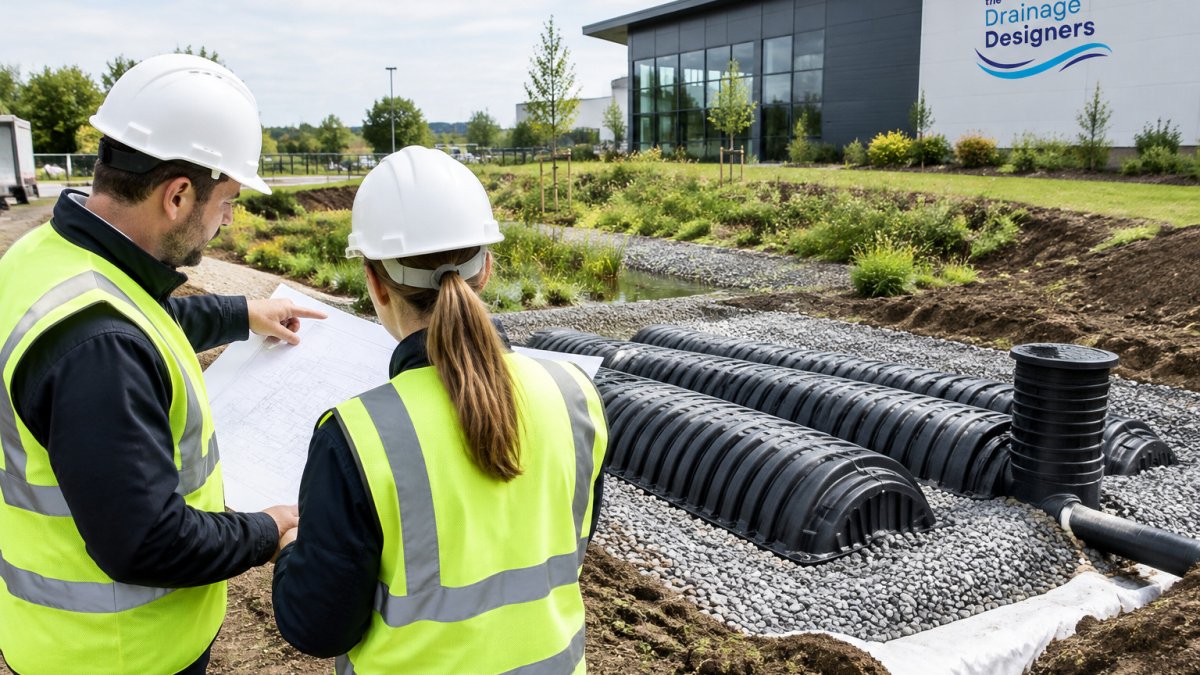
- Attenuation basins that hold water temporarily
- Permeable paving
- Swales and filter strips
- Infiltration trenches
- Detention ponds
Capacity is a common point of failure. A system sized for today's rainfall can fall short once the climate change allowance is applied.
If the phrase "SuDS compliant" is still fuzzy for you, our clear guide to what SuDS compliant means explains it without jargon.
SuDS Maintenance and Adoption: Who Owns the System After Handover
SuDS maintenance and adoption is the question of who looks after the drainage system once the development is finished. If nobody owns it, it fails. That is the short version.
There are usually three routes:
- Adoption by the water company or local authority: the system transfers to a statutory body
- A management company: residents or a third party pay for upkeep
- Private ownership: the developer or landowner retains responsibility
Each route needs to be agreed before construction, not after. Councils increasingly refuse schemes where long-term maintenance is unclear.
A maintenance plan should state:
- What needs checking and how often
- Who carries out each task
- How costs are funded
- What records are kept
Watch out: if adoption is assumed but never formally agreed, the developer can be left paying for maintenance years after the last house is sold.
To secure adoption, you will typically need to provide:
- Detailed design drawings and calculations
- A maintenance schedule and manual
- Evidence of construction to the approved specification
- As-built surveys and inspection records
- A commuted sum or bond where required
The adopting body will inspect the system before taking it on. Any defects must be remedied first.
A common pattern is for developers to assume the water company will adopt SuDS, only to find the system does not meet the required standards.
If adoption is not possible, a management company is often the fallback. This requires setting up a legal entity and funding mechanism, which takes time.
Private ownership is the least desirable option for developers because it leaves them with ongoing liability. However, it may be the only option for some systems, such as those serving commercial units.
Ultimately, the adoption route should be decided at the planning stage and reflected in the drainage strategy.
Drainage Rights, Easements and Securing Your Outfall
Drainage rights and easements give you the legal right to run water across or under land you do not own, and to connect to an outfall. Without them, a perfectly good design cannot be built.
An outfall is the point where your surface water leaves the site, whether that is a watercourse, a public sewer or an infiltration feature. Securing it early is essential.
The practical checks are straightforward:
- Identify every piece of land your pipes cross
- Confirm who owns it and whether rights already exist
- Agree easements in writing, with plans
- Check the outfall has capacity and permission to receive your flows
- Record everything for the planning file
A common mistake is assuming a nearby watercourse or sewer is available. It may be private, at capacity, or subject to restrictions. We check outfall options before design work starts, because a missing right can sink a scheme faster than any technical issue.
Surveys, Evidence and Documentation for First-Time Sign-Off
First-time sign-off depends on evidence. Councils and building control approve what they can see, so the survey and documentation trail matters as much as the design.
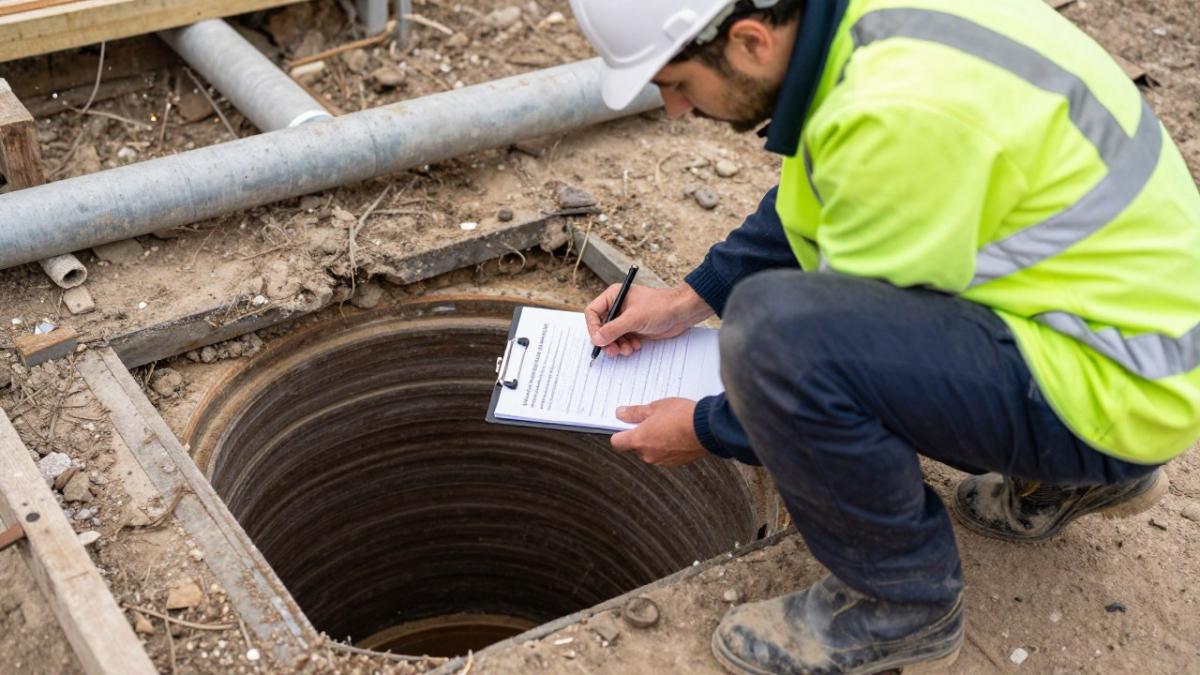
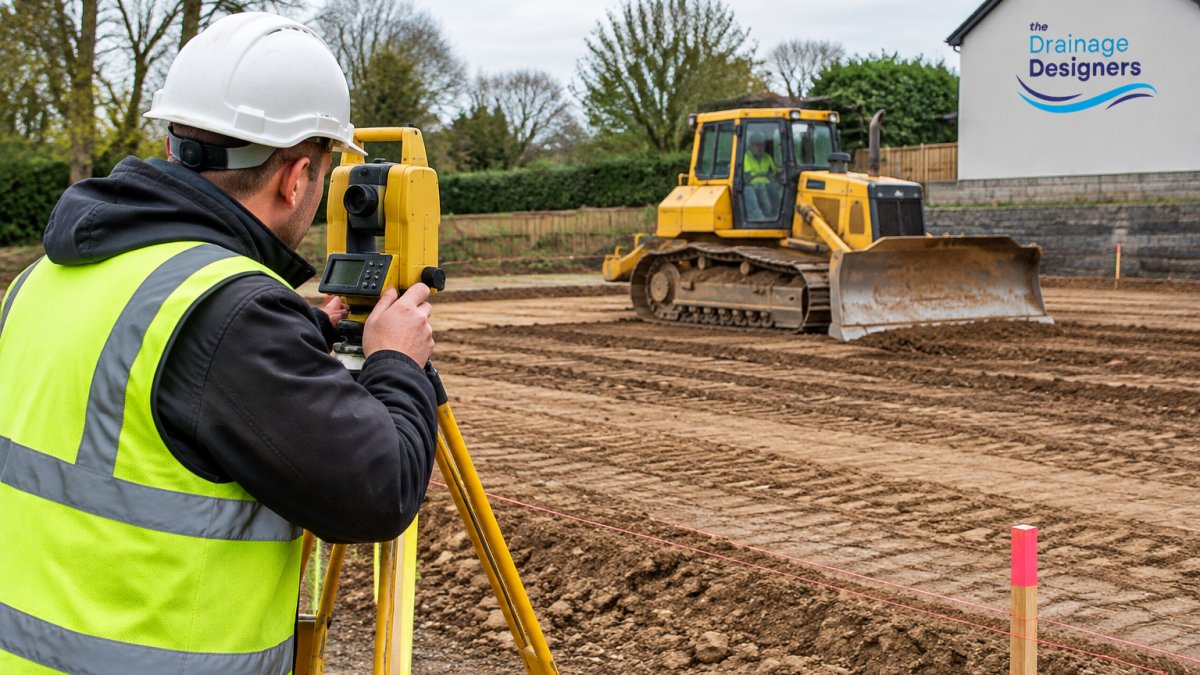
Start with an existing drainage survey. A CCTV survey and manhole inspection can show what is already underground, including pipes that may not appear on any map.
The evidence pack should include:
- Topographical and drainage survey results
- CCTV survey footage and reports
- Design calculations for surface water and foul water
- Construction details and drawings
- Inspection records during the build
- Maintenance and adoption documents
Keep records as you go. Chasing paperwork at the end of a project is where delays creep in.
For a step-by-step walkthrough of the report itself, see our guide to the drainage strategy report for planning.
| Stage | Key Action | Evidence to Keep |
|---|---|---|
| Pre-application | Check flood zone and outfall options | Flood zone map, outfall correspondence |
| Design | Model runoff and size SuDS | Calculations, drawings |
| Planning | Submit drainage strategy | Strategy report, FRA |
| Pre-construction | Survey existing drainage | CCTV report, manhole records |
| Construction | Inspect and record | Inspection sheets, photos |
| Handover | Agree adoption and maintenance | Adoption agreement, maintenance plan |
Each piece of evidence serves a purpose. The flood zone map proves you have considered flood risk. The outfall correspondence shows you have permission to discharge.
A common gap is the lack of as-built information. Councils want to see that what was built matches what was approved.
Watch out: if you leave documentation to the end, you may find that records are incomplete or lost. Make it someone's responsibility to collate evidence as the project progresses.
Finally, consider a pre-submission review. An independent check of your evidence pack can catch omissions before the council does.
Book a Drainage Design Review Before Your Next Submission
Drainage problems rarely fix themselves, and resubmissions cost time and money. A design review before you submit catches the gaps that trigger conditions and refusals.
We work with homeowners, architects and developers across the UK, from small extensions to commercial schemes. Our services cover site visits, flood risk assessments and council approvals.
Here is how we help:
- Nationwide coverage across the UK
- Comprehensive service, from site visits to final approvals
If you are ready to move, you can read about our drainage design process and see what a review involves. Then get in touch with The Drainage Designers and submit with confidence.
Drainage compliance is not a hurdle to clear at the end. It is the thread that runs through your whole project, from the first site check to the final handover. Get it right at each stage and approvals follow. Get it wrong and the programme pays for it. The Drainage Designers can review your design, check your evidence and help you submit a scheme that stands up first time. Get started with The Drainage Designers and give your next application the best chance of a clean approval.
Frequently Asked Questions
Why is drainage compliance important for property developers?
Drainage compliance sits behind three things developers care about: planning approval, build cost and saleability. Councils and lead local flood authorities can refuse or condition permission when surface water and foul water arrangements are unresolved, and unresolved drainage rights can stall a site after permission is granted. Getting drainage compliance right early also protects development viability, because retrofitting attenuation, outfalls or SuDS after construction costs far more than designing them in. It also reduces rework and project delays during inspection stages.
What drainage information is needed for planning permission?
Most applications need a drainage strategy showing how foul water and surface water will be managed, including connection points, attenuation volumes and outfall arrangements. Where flood risk applies, a flood risk assessment for planning will also be required, covering the site's flood zone, finished floor levels and climate change allowance for the design storm event. Supporting evidence usually includes an existing drainage survey, a CCTV survey where pipes are being reused, and confirmation from the sewerage undertaker or lead local flood authority on the proposed approach.
When is a drainage strategy required for a development?
A drainage strategy is expected on most new-build schemes and on extensions or conversions that change impermeable area or add dwellings. The trigger varies by local authority, so check the validation checklist before submitting. As a rule, if your proposal creates new runoff, connects to a public sewer, or sits in an area with known flooding, assume a strategy will be requested. Preparing it early avoids a validation refusal and keeps the determination timetable intact.
What can happen if a development does not meet drainage requirements?
Outcomes range from a refused application or pre-commencement condition you cannot discharge, through to enforcement action after completion. Building control can also withhold completion certification where drainage is not built to the approved design. Financially, the bigger risk is often at sale: solicitors acting for buyers will ask for adoption agreements, maintenance schedules and evidence of sign-off, and missing paperwork can delay or reduce offers. Early drainage compliance is cheaper than resolving these issues later.