 Knowledge Centre
LLFA and Local Authority Drainage Compliance
Table of Contents
- Who Approves Drainage on Construction Projects
- Flood Risk Assessment for Planning Applications
- Writing a Construction Drainage Management Plan
- Drainage Planning Conditions Discharge: Step by Step
- SuDS Maintenance and Adoption After Completion
- Common Pitfalls in Drainage Compliance
- Frequently Asked Questions
Last Updated: 16 October 2026
Who Approves Drainage on Construction Projects
Two separate bodies can hold up your drainage proposals, and confusing them is the most common reason applications stall. The Lead Local Flood Authority (LLFA) is the county or unitary authority responsible for managing local flood risk from surface water, groundwater and ordinary watercourses. The Local Planning Authority (LPA) is the council department that determines your planning application and attaches the conditions your drainage must satisfy.
Compliance with local authority and lead local flood authority requirements for construction management means satisfying both bodies at once: the LLFA advises on flood risk and surface water strategy, while the LPA decides whether to grant permission and on what terms. At The Drainage Designers, we see this split trip up homeowners and architects alike, because a scheme that satisfies one body can still be refused by the other.
What a Lead Local Flood Authority Does
The LLFA is a statutory consultee on major planning applications. It reviews your surface water drainage strategy, checks that runoff rates and volumes are controlled, and confirms whether Sustainable Drainage Systems (SuDS) have been considered in line with the National Planning Policy Framework and its supporting planning practice guidance. The LLFA does not grant permission. It advises the LPA, and that advice carries significant weight.
For householder and minor applications, the LLFA is usually not consulted directly, but the LPA can still require a drainage strategy as a condition. That distinction matters: a small extension may avoid formal LLFA scrutiny yet still need to demonstrate compliant surface water management.
How Local Planning Authorities Fit In
The LPA is the decision-maker. It interprets the LLFA's advice, applies local plan policy, and sets the conditions that govern how drainage is built, maintained and adopted. When the LPA grants permission subject to a drainage condition, that condition becomes a legal requirement. You cannot discharge it informally, and you cannot start the relevant works until it is formally cleared.
In practice, this means your drainage design must be readable by two audiences with different priorities. The LLFA wants technical evidence on flood risk and runoff. The LPA wants assurance that the condition can be discharged and that maintenance arrangements are secure.
Flood Risk Assessment for Planning Applications
A flood risk assessment for planning applications identifies whether your site is at risk of flooding from any source and sets out how that risk will be managed. For sites in Flood Zones 2 or 3, or larger than one hectare in Flood Zone 1, a site-specific assessment is normally required. The assessment covers fluvial, surface water, groundwater, sewer and reservoir flood risk, and it must account for climate change over the development's lifetime.
Three things decide whether an assessment is accepted or returned:
- Sequential test evidence. You must show that lower-risk sites were considered before this one.
- Finished floor levels. Proposed levels must sit above the modelled flood level plus an allowance for climate change.
- Safe access and egress. Occupants need a dry route to safety during a design flood event.
A common mistake is treating the flood risk assessment as a formality and commissioning it after the layout is fixed. By then, the only compliant answer may be to move the building, which is far more expensive than designing around the flood envelope from the start.
Writing a Construction Drainage Management Plan
A construction drainage management plan sets out how surface water will be managed during the build, not just after completion. It should state the pre-development runoff rate, the proposed discharge rate, the drainage hierarchy applied, and the temporary measures that keep silt and sediment out of the receiving system.
The plan needs to answer four questions clearly:
- Where does surface water go during construction?
- What controls the discharge rate, and how is it calculated?
- How will silt, fuel and sediment be prevented from entering watercourses or sewers?
- Who inspects the measures, and how often?
What most guides miss is that the plan must align with the flood risk assessment. If the assessment models a discharge rate of five litres per second, the management plan cannot propose eight. Inconsistency between documents is one of the fastest ways to trigger a condition query.
Drainage Planning Conditions Discharge: Step by Step
Discharging a drainage condition is a formal application to the LPA, and it follows a defined sequence. You submit the requested information, the LPA consults the LLFA where relevant, and the condition is either discharged, refused, or queried. Until it is discharged, the condition remains outstanding and can block commencement or occupation.
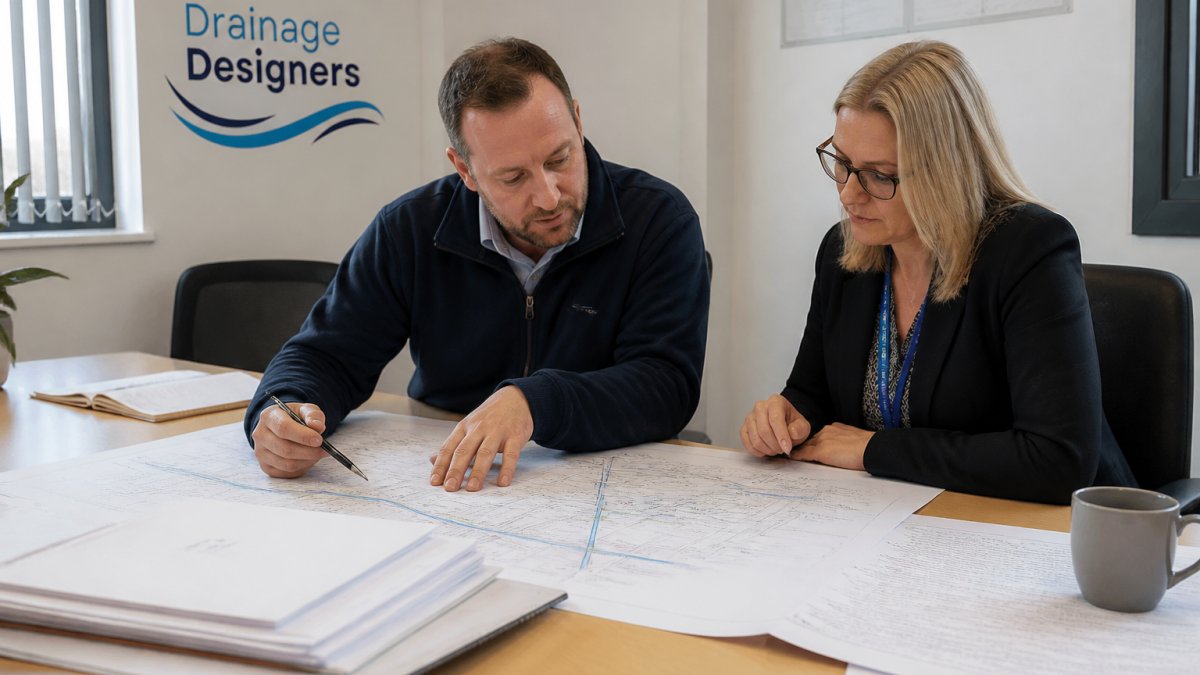
Step 1: Read the condition exactly. Conditions are worded precisely. If it asks for a maintenance schedule, submitting only a layout drawing will not discharge it.
Step 2: Prepare the evidence pack. This typically includes drainage layout drawings, hydraulic calculations, the flood risk assessment, the maintenance schedule and the management plan.
Step 3: Submit the discharge application. Use the LPA's online portal and pay the fee. Fees vary by authority and application type, so check the current schedule on your council's website rather than relying on an old figure.
Step 4: Respond to queries promptly. The LPA may consult the LLFA and return with technical questions. Slow responses extend the determination period.
Step 5: Confirm discharge in writing. Keep the written confirmation. It is your evidence that the condition no longer restricts the works.
| Stage | Typical Action | What Can Go Wrong |
|---|---|---|
| Condition review | Read wording line by line | Submitting partial evidence |
| Evidence pack | Drawings, calculations, schedule | Documents contradict each other |
| Submission | Portal application plus fee | Wrong fee or wrong form |
| Query response | Answer LLFA questions | Slow replies extend timelines |
| Discharge | Written confirmation | Proceeding without it |
SuDS Maintenance and Adoption After Completion
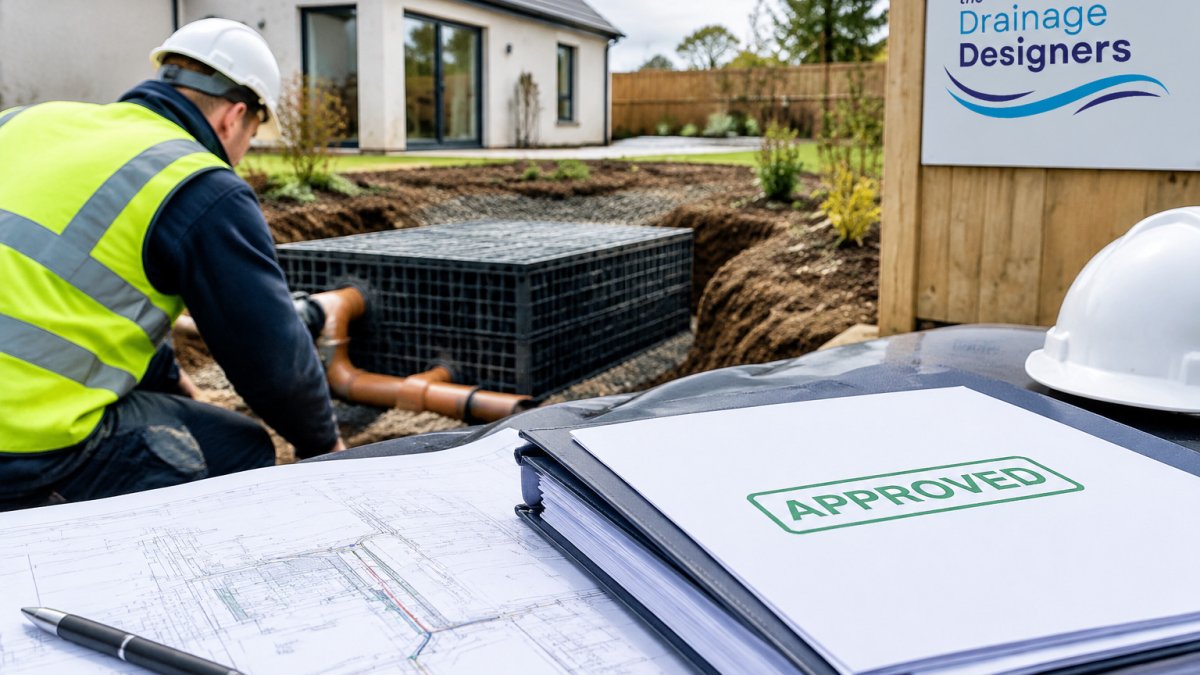
SuDS maintenance and adoption determine who looks after the drainage system once the site is occupied. Options include adoption by the local authority, adoption by a water company under a Section 104 agreement, or retention by a private management company or the homeowner. Each route has different design and access requirements, and the choice must be made early.
A maintenance schedule is almost always required. It should list each SuDS component, the maintenance task, the frequency and the responsible party. For a domestic extension, this may be as simple as a short schedule for a soakaway or permeable paving. For larger schemes, it will cover attenuation tanks, swales, basins and flow control devices.
The thing nobody tells you about adoption is that the adopting body will inspect the system before accepting it. If the as-built drainage does not match the approved design, adoption can be refused, leaving the developer responsible for maintenance indefinitely.
Common Pitfalls in Drainage Compliance
Most drainage refusals trace back to a small number of recurring errors, and nearly all of them are avoidable with earlier coordination. These are the ones we see most often.
- Commissioning drainage design too late. By the time the architect has fixed the layout, the compliant options have narrowed.
- Ignoring the drainage hierarchy. Priority should go to infiltration, then discharge to a watercourse, then to a surface water sewer, with combined sewers as a last resort.
- Underestimating climate change allowances. Runoff calculations must use the current allowances, which are updated periodically.
- Inconsistent documents. If the flood risk assessment, drainage strategy and management plan disagree, expect a query.
- No maintenance plan. Conditions frequently require one, and its absence delays discharge.
- Assuming all authorities want the same thing. Requirements differ between councils, so a design accepted elsewhere may not be accepted here.
Drainage compliance is rarely difficult in isolation. It becomes difficult when the flood risk assessment, the drainage strategy and the condition discharge are handled as separate tasks by separate people. The Drainage Designers bring them together, from site visits and flood risk assessments through to securing local council approvals, so your drainage design is compliant with Local Authority and Lead Local Flood Authority requirements and your project stays on schedule. Get in touch to discuss your site and find out how we would approach it.
Frequently Asked Questions
What does a lead local flood authority do?
A lead local flood authority (LLFA) is usually the county council or unitary authority. It manages local flood risk from surface water, groundwater and ordinary watercourses. As a statutory consultee on major planning applications, it reviews drainage strategies and can object if a scheme fails to manage surface water properly. Meeting LLFA requirements early avoids delays and helps secure drainage compliance.
When must a construction project consult the lead local flood authority?
The LLFA must be consulted on major developments, generally 10 or more homes or sites over 0.5 hectares. For smaller schemes, the local planning authority may still seek advice. Early engagement, before submitting a flood risk assessment for planning applications, reduces the risk of objections. Your drainage consultant should confirm whether your project triggers consultation.
What drainage information may a local planning authority require for a planning application?
The local planning authority may request a flood risk assessment, a surface water drainage strategy, a construction drainage management plan, and details of SuDS maintenance and adoption. Requirements vary by authority, so checking the local validation checklist is essential. Providing this information upfront supports a smooth drainage planning conditions discharge.
How do sustainable drainage systems affect planning approval?
SuDS manage surface water through features such as permeable paving, swales and attenuation tanks. Many local authorities expect SuDS to be included unless ground conditions or contamination make them impractical. A well-designed SuDS scheme can satisfy LLFA requirements and improve drainage compliance, but it must be backed by calculations and a maintenance plan.
What should a construction drainage management plan include?
A construction drainage management plan should cover temporary drainage during construction, pollution prevention measures, silt control, and a timetable for installing permanent drainage. It also needs details of who is responsible for each task. This plan is often required to discharge drainage planning conditions.
Who is responsible for maintaining sustainable drainage systems after construction?
Responsibility depends on the adoption arrangement. SuDS may be adopted by the local authority, a water company, or a private management company. If not adopted, the homeowner or site owner usually retains responsibility. A clear SuDS maintenance and adoption plan should be agreed before construction begins to avoid future disputes.