 Knowledge Centre
Benefits of Climate Resilient Drainage for Property Developers
Last Updated: 23 October 2026
Quick Summary
The benefits of climate resilient drainage for property developers in the UK include fewer planning refusals, lower flood damage, easier approvals and a scheme that still performs in thirty years. Designing systems that manage water at source, slow it down and release it safely keeps a site working when the weather turns.
- Climate resilient drainage manages surface water using attenuation basins, permeable paving and swales sized for future rainfall.
- A complete drainage submission includes a surface water drainage strategy with calculations and climate change allowances.
- Skipping the climate change allowance is one of the most common reasons a drainage strategy is sent back.
- A SuDS maintenance and management plan sets out who looks after each feature and how often.
- Book a drainage review before finalising the layout to avoid weeks of resubmission later.
Table of Contents
- Why Climate Resilient Drainage Matters for Property Developers
- How Climate Resilient Drainage Reduces Flood Risk on Development Sites
- SuDS Planning Application Requirements Developers Must Meet
- Using a Surface Water Flood Risk Assessment for Planning
- SuDS Design Examples for Housing Developments
- The SuDS Maintenance and Management Plan: Protecting Long-Term Performance
- Common Mistakes Developers Make with Drainage Design
- Frequently Asked Questions
Why Climate Resilient Drainage Matters for Property Developers
Flood risk is now a planning issue on almost every site. A drainage scheme that works on a dry day is no longer enough. Planning authorities, Lead Local Flood Authorities and insurers all want evidence that a development can cope with heavier rainfall and longer dry spells over its whole life.
That is the practical case for the benefits of climate resilient drainage for property developers in the UK. At The Drainage Designers, we design systems that manage water at source, slow it down and release it safely, so a site keeps working when the weather turns. The benefits of climate resilient drainage for property developers in the UK come down to four things: fewer planning refusals, lower flood damage, easier approvals and a scheme that still performs in thirty years.
Climate resilient drainage is a design approach that manages surface water using features such as attenuation basins, permeable paving and swales, sized for future rainfall rather than historic records. It is not a single product. It is a way of thinking about a whole site.
Get it right early and the rest of the project gets simpler. Get it wrong and you will be resubmitting plans while the build programme slips.
How Climate Resilient Drainage Reduces Flood Risk on Development Sites
Flood risk falls when water is slowed, stored and cleaned before it reaches a sewer or watercourse. Conventional drainage pipes rainfall away as fast as possible. Climate resilient systems do the opposite: they hold it back, spread it out and let it soak or drain away gradually.
On a development site, that means:
- Less pressure on public sewers during heavy storms, which reduces the risk of backing up and flooding.
- Storage built into the site, such as basins or tanks, so peak flows are cut before discharge.
- Cleaner water leaving the site, because features like swales and filter strips trap silt and pollutants.
- A safer site during construction, with fewer standing pools and washouts.
The wider drainage industry now plans for heavier rainfall as standard. Guidance from the Environment Agency on flood risk and climate change sets out how schemes should account for future rainfall. Build to those allowances and your drainage keeps working when storms get more intense.
SuDS Planning Application Requirements Developers Must Meet
Most drainage refusals come from missing information, not bad engineering. SuDS planning application requirements vary by authority, but the core is consistent. You need to show what the water will do, where it will go and who will look after it.
A complete drainage submission usually includes:
- A surface water drainage strategy with calculations
- Evidence that you have followed the drainage hierarchy, using infiltration or watercourses before sewers
- Allowances for climate change in the rainfall figures
- A maintenance and management plan
- Confirmation from the Lead Local Flood Authority where they are a statutory consultee
Local authorities also expect applicants to follow the government's planning practice guidance on flood risk and coastal change. Read it before you submit. It saves a round of questions.
If your scheme is small, the specific rules that apply to it are worth checking in detail. Our guide to SuDS requirements for small developments sets out what a small scheme needs to include.
Using a Surface Water Flood Risk Assessment for Planning
A surface water flood risk assessment for planning shows how rainwater will behave across your site, both now and in the future. It looks at where water flows, where it ponds and how your development changes that picture. Planners use it to judge whether the scheme is safe and whether it makes flooding worse elsewhere.
The assessment typically covers:
- Existing drainage and overland flow routes
- Flood depth and extent for a range of storm events
- The effect of climate change on those events
- How the proposed layout manages water
- Any off-site impacts
For sites near ordinary watercourses or with a history of flooding, this document often decides the application. Get it right and the LLFA is far more likely to sign off without conditions.
If you need to understand the wider requirements around this document, our guide to surface water management plan requirements covers what is expected.
SuDS Design Examples for Housing Developments
Good SuDS design fits the site, not a template. Two housing schemes on the same street can need completely different solutions depending on soil, slope and space.
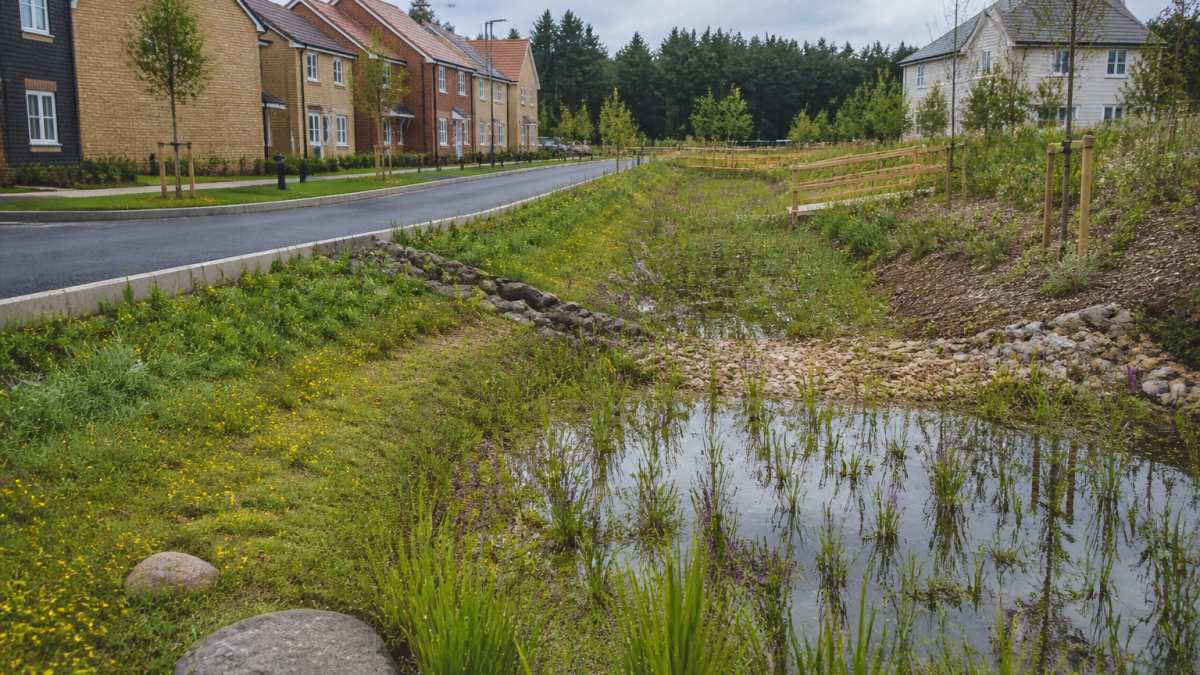
Common options for housing schemes include:
- Detention basins in open space, holding storm water and emptying slowly.
- Swales along roads and boundaries, moving and cleaning water above ground.
- Permeable paving on driveways and parking, letting water through to the ground below.
- Rain gardens in front gardens, taking roof water from downpipes.
- Underground attenuation where space is tight, such as crates or tanks beneath parking.
The best schemes combine several of these. A mix gives you resilience if one feature underperforms and makes maintenance easier. For a wider set of worked options, our article on sustainable urban drainage solutions for small sites shows how these fit together.
The article sets out the common SuDS features used on housing schemes and what each one does.
| Feature | Where it is used | What it does |
|---|---|---|
| Detention basins | In open space | Hold storm water and empty slowly |
| Swales | Along roads and boundaries | Move and clean water above ground |
| Permeable paving | Driveways and parking | Let water through to the ground below |
| Rain gardens | Front gardens | Take roof water from downpipes |
| Underground attenuation | Where space is tight | Crates or tanks beneath parking |
The SuDS Maintenance and Management Plan: Protecting Long-Term Performance
A SuDS maintenance and management plan sets out who looks after each drainage feature, how often, and what happens if it fails. Without one, even a well-designed system silts up, blocks and stops working within a few years.
A good plan lists:
- Every drainage feature on the site
- The maintenance task for each, and how often it is needed
- Who is responsible, whether the developer, a management company or a homeowner
- What records need keeping
- How to access each feature for inspection
Planners increasingly refuse schemes that lack this document. It is also what protects the developer after handover, because it shifts clear responsibility to the people who will own the system.
If you are preparing one, our complete guide to the SuDS management plan walks through what to include.
Common Mistakes Developers Make with Drainage Design
Most drainage problems are avoidable. They come from leaving drainage until the layout is fixed, or from treating it as paperwork rather than design.
The errors we see most often:
- Designing drainage last, after roads and plots are set, leaving no space for basins or swales.
- Ignoring ground conditions, then finding infiltration will not work.
- Forgetting climate change, so the system is undersized from day one.
- No maintenance plan, which leads to conditions and delays at approval.
- Poor ground level design, so water ponds where it should drain.
Each of these costs time and money. Fixing them at design stage is far cheaper than fixing them after a refusal. For a fuller list, our page on common drainage design mistakes sets out the pitfalls and how to avoid them.
Drainage is one of the few parts of a scheme that can stall an otherwise strong application. The fix is straightforward: design it early, size it for future rainfall and document it properly. The Drainage Designers handle site visits, flood risk assessments and full drainage design, and we work with your local authority and Lead Local Flood Authority to keep approvals on track. Our nationwide service and transparent customer charter mean no surprises. Get in touch to discuss your project and secure a compliant drainage design that stands up to scrutiny.
Frequently Asked Questions
What is climate resilient drainage and why does it matter for developers?
Climate resilient drainage is a design approach that manages surface water so a site can cope with heavier rainfall and more frequent storms. For developers, it matters because poorly managed water leads to flooding, planning conditions and long-term maintenance liabilities. Systems built around climate resilient drainage principles, such as SuDS, slow the flow of water and reduce pressure on sewers. This supports planning approval and protects the value of the completed development.
Do property developers need SuDS approval for a planning application?
In most cases, yes. SuDS planning application requirements mean you must show how surface water will be managed before planning permission is granted. Many local planning authorities now expect a drainage strategy, and the Lead Local Flood Authority will review it. Getting the design right early avoids conditions and delays. A clear SuDS strategy covering attenuation, treatment and maintenance is usually needed to support a successful application.
Who is responsible for maintaining SuDS after a development is completed?
Responsibility depends on the agreed SuDS maintenance and management plan. It may sit with a management company, a local authority, or a private contractor. Developers should set out maintenance responsibilities clearly before handover. Without a plan, systems can fall into disrepair and cause flooding or legal disputes. A written schedule of inspections and upkeep protects both the developer and future residents.
How can a surface water flood risk assessment help secure planning permission?
A surface water flood risk assessment for planning identifies where water could collect, flow or flood on and around the site. It gives the local authority evidence that your drainage design manages risk properly. The assessment can highlight constraints early, so you can adjust layout and attenuation before submission. This reduces the chance of refusal or costly conditions and supports a smoother route to approval.